


Last week I sat in a meeting booth on a zoom call for ten minutes waiting for people to join. They didn’t. Why? Because the meeting was in person. In a different office. Starting nine minutes ago.
I’d been staring at an empty Zoom room for a meeting that was an hour away.
I laughed.
Not the polite kind. The kind where you realize your brain is running too many threads and something just segfaulted.
I showed up late, walked in, and told them exactly what happened.
They laughed too.
We started the meeting lighter than we would have otherwise. No tension. No performance. Just people who recognized the absurdity of trying to hold too much at once.
The day I stop finding things like this funny is the day I need to think hard about my work-life balance and whether I’m on the edge of burnout (or over it).
Been there. Seen that. Done that.
Now laughter is my canary in the coal mine.
No laughter? The canary’s dead. Time to run.

Writing about anti-resolutions in my last essay (and trying to be funny while doing it) got me thinking more deeply about the role of humor when everything’s falling apart, and about the line between humor that builds resilience and cynicism that poisons it.

Using humor when everything’s on fire
Stress doesn’t announce itself with a memo.
It shows up quietly. You stop joking. You stop finding things absurd. Everything becomes heavy, serious, a problem to solve rather than a moment to experience.
Laughter doesn’t just make hard situations easier to bear, it’s also a diagnostic.
When I can still laugh, especially at my own expense, I know I have capacity. When I can’t, I know I’ve crossed a line.
You might not believe this but… humor matters more when things are falling apart, not less.
When the system’s flaking, the deadline’s unrealistic, and a couple of people just quit, that’s exactly when you need someone who can look at the situation and say something true in a way that cuts the tension.
Not to dismiss the problem, but to make it survivable.
The mechanics of laughter (skip this part if you can’t stand a little science)
Psychologically, laughter is a bonding mechanism.
It triggers neural pathways tied to trust and safety. People who laugh together are more likely to collaborate, more willing to share bad news, and more tolerant of each other’s flaws.
This isn’t some urban legend or soft skills mysticism. Research from Wharton, MIT, and London Business School shows that “laughter relieves stress and boredom, boosts engagement and well-being, and spurs not only creativity and collaboration but also analytic precision and productivity”.
The data is staggering:
After watching a comedy clip, employees were 10% more productive than their counterparts
Humor at work can boost job satisfaction by 33%
91% of executives believe humor is crucial for career advancement
Even the FBI trains agents in humor. Not as a distraction technique, but because humor helps build rapport, reduce status differentials, and makes work more human.
If federal agents investigating crimes can find applications for humor, you probably can too.
The Mayo Clinic even mapped the physiology1. Laughter enhances your intake of oxygen-rich air, increases your brain’s release of endorphins, and stimulates circulation. It fires up and then cools down your stress response. The result? A good, relaxed feeling that actually reduces the physical symptoms of stress.
Long-term, laughter can improve your immune system, relieve pain by triggering the body’s natural painkillers, and lessen depression and anxiety.
In leadership, humor becomes a stealthy form of influence.
It builds rapport. It opens doors that formal authority can’t. And perhaps most crucially, it lets people know you’re not a robot in a human-skin. Robo-dance doesn’t count as a proof you’re a robot.
Harvard Business School research found that cracking jokes at work can make people seem more competent, not less. The well-timed quip signals mental agility: “you’re demonstrating that you can hold multiple ideas in mind, recognize subtle contradictions, and walk through social norms with just enough irreverence to make a point without crossing a line”.
So… A well-timed joke can be an evidence of emotional and intellectual fluency. But the emphasis is on a “well-timed”.
Teams that laugh more tend to innovate more. Leaders who joke (within reason) foster environments where unconventional ideas can surface without someone immediately stomping them out with “That’s not how we do things here.”
Playfulness breaks rigid thinking. Laughter makes space for the unexpected.
If you’re trying to build systems that adapt instead of calcify, you need people who can laugh when the plan doesn’t survive contact with reality.
But there’s humor and there’s humor
Not all laughter is the same.
Humor is not the main course. It’s a condiment.
Analysis of nearly a million patient comments2 about their healthcare experiences revealed something crucial. When patients felt their doctors showed empathy, kindness, and respect, humor amplified those positive signals. They wrote things like, “The nurse was caring, answered all my questions, and had a sense of humor — I liked that.”
But when patients perceived a lack of respect, humor didn’t just fall flat. It made things worse.
One patient wrote: “The doctor was the only one to show no respect and even joke at a question I was concerned about.”
Same tool. Opposite outcomes.
Humor isn’t a stand-alone asset or liability. It amplifies whatever signal you’re already sending.
If your team trusts that you care, humor becomes a way to connect, to lighten the load, to make hard things bearable. If they don’t, your joke becomes evidence of dismissiveness.
This means you can’t use humor to shortcut the real work of leadership. You can’t skip empathy, kindness, and respect and hope a well-placed joke fixes it.
Humor works when it’s built on a foundation of genuine care. Without that foundation, it collapses into something else entirely.
Racist or discriminatory jokes?
Never. Not funny. Not leadership. Just damage. These jokes don’t just offend — they sustain discrimination and assault inclusion.
Failed humor?
Costs you. Badly timed or tone-deaf jokes lower your status and perceived competence. If you’re not sure it will land, don’t say it. Or… say it enough times and eventually time might laugh with you.
“I’m just joking” as cover?
Some people use humor as an excuse for careless, bullish, or abusive behavior. They hide behind “Can’t you take a joke?” when called out. That’s not humor. That’s toxicity wearing a mask. Huge red flag. Visible from outer space.
The uncomfortable part: people with power often get away with it. The senior leader who makes a cutting remark about someone junior and calls it “banter”? The executive who punches down and gets laughs from the in-group? That’s not leadership. That’s exploitation of status.
Real banter vs. fake banter
There’s a world of difference between actual banter and what people call banter when they get called out.
Real banter happens between people who know each other well. People who’ve built enough trust to push boundaries without breaking things.
Some of this banter emerges naturally from the roles themselves. Product wants more features. Engineering wants more time. Frontend and backend joke about whose code is harder. These tensions are structural. Banter acknowledges them openly rather than letting them fester into resentment.
My team does this. We joke, we push, we test the edges. And we have a mechanism: when someone says “This escalated quickly” with a chuckle, that’s the signal. Pull back. Return to safer terrain. No resentment, just recalibration.
Simple test: if everyone’s laughing, especially the person on the receiving end, you’re in the safe zone.
If only the person delivering the joke finds it funny, it’s not banter. It’s cruelty dressed up as humor.
One-sided “banter” goes in the same bucket as cynicism. Toxic. Corrosive. Don’t let it spread.
Humor without the foundation of respect isn’t funny. It’s harm disguised as levity.
Gallows humor?
Sometimes exactly what you need. But only in safe spaces where everyone’s in on it. The team that jokes about the disaster while firefighting together isn’t being callous. They’re surviving. There’s a difference.
Sarcasm?
Occasionally. But not at someone else’s expense unless they find it funny too. Sarcasm aimed down is cruelty. Sarcasm aimed up or at yourself can be truth-telling.
Cynicism?
Never.
This is the real enemy.
Cynicism isn’t humor. It’s humor’s evil twin.
Gallows humor says, “This is absurd, and we’re going to get through it anyway.”
Cynicism says, “This is absurd, nothing will ever change, and we’re all idiots for trying.”
One builds resilience. The other poisons it.
Cynicism spreads. It’s contagious in the worst way. One cynic in the room can turn every conversation into a referendum on futility.
And once it takes root, it’s almost impossible to unwind.
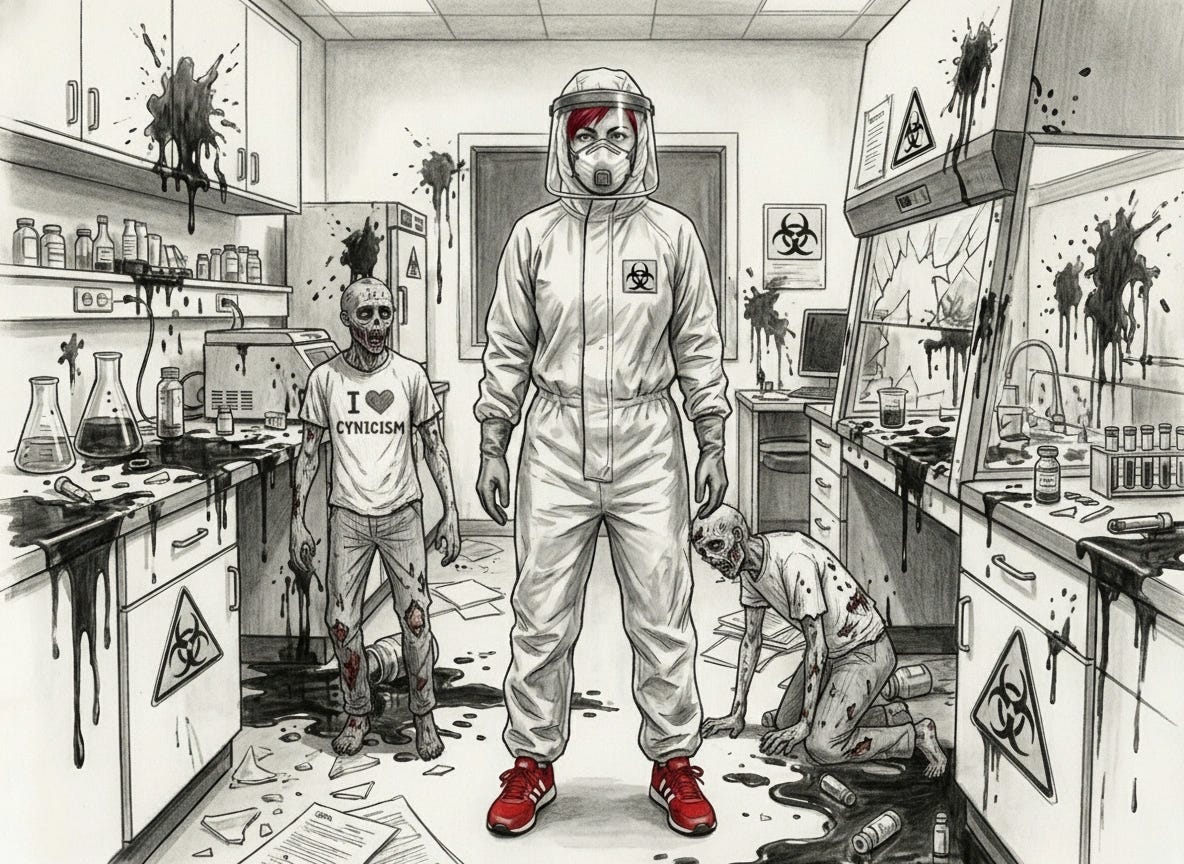
If you hear yourself or your team slipping into cynical humor, stop it. Fast.
The line between “laughing at the chaos” and “giving up on fixing it” is thinner than you think.
How to actually do this
If you’re thinking, “Great, but I’m not funny,” stop.
Humor can be learned. It’s a skill, not a personality trait you’re either born with or without.
Research shows that even forced laughter can turn into spontaneous laughter over time. Your brain doesn’t care if you started by faking it. The benefits show up anyway.
Just don’t try to become a stand-up comedian. You’re trying to bring a bit of lightness into hard moments.
Aim for smiles, not laughs.
You don’t need to land a killer punchline in every meeting. Start small. A cheesy dad joke at the start of a standup. A wry observation about the absurdity of your 47th Zoom call that day. A self-aware comment about your own chaos.
If you’re aiming for big laughs, you’re trying too hard. Aim for the slight upturn at the corner of someone’s mouth. That’s enough.
Use self-deprecating humor.
Leaders who can laugh at themselves build trust faster than those who project invincibility.
Bad at remembering names? Admit it with a smile. Show up to the wrong meeting like I did? Tell the story. Made a typo in the all-hands slide deck? Own it.
Self-deprecating humor shows vulnerability and humility. It reminds your team that you’re human too.
Just keep it light. There’s a difference between “I clearly had too much coffee before making this deck” and “I’m terrible at everything and probably shouldn’t be in this role.”
One is relatable. The other is concerning. I’m sure you know which’s which.
Read the room.
Humor is subjective. What lands with one team might crash with another.
Before you crack a joke, consider the culture, the context, and the people around you. Keep it inclusive. Avoid anything that punches down or could be misinterpreted.
And if you’re not sure what your team finds funny? Pay attention. Notice what makes them laugh. Start a Slack channel for memes. See what gets shared.
The goal isn’t to perform. It’s to connect.
Timing is everything
There’s a time for jokes and a time when there isn’t.
But here’s the tricky part: there’s also a time when there should be room for a joke, but there isn’t.
You’re like Indiana Jones in a temple full of traps and secret passages.
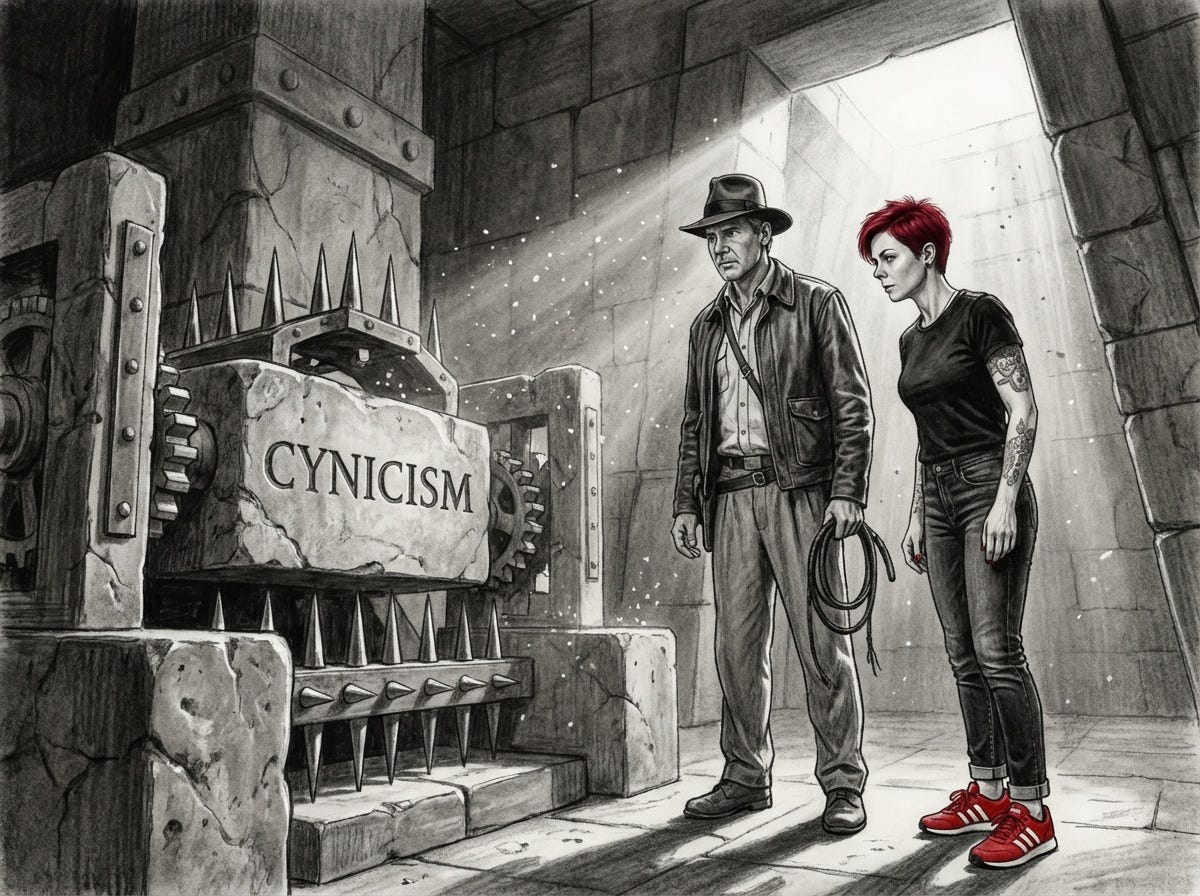
You have to be adventurous enough to let humor into your leadership. But also careful enough not to step on the wrong stone and release the poison darts.
The skill isn’t knowing every perfect moment. It’s learning to read the room, to know when lightness creates space and when it dismisses pain.
As one Harvard Medical School professor put it, “Laughter is a social signal among humans. It’s like a punctuation mark.”
Sometimes the right move is a joke that breaks tension — the exclamation point in the middle of a stressful day. Sometimes the right move is silence and presence.
The leaders who get this right don’t follow a script. They pay attention.
They notice when the team needs relief and when they need gravity. When humor will bond and when it will alienate. When a laugh will cut through anxiety and when it will feel like dismissal.
This requires presence. You can’t phone it in and crack jokes from muscle memory.
Using humor well demands intense attention to the moment and authenticity in conveying that you care. When you get it right, something shifts. People feel seen, heard, and not alone in whatever they’re carrying.
That’s what humor does when it’s working. It doesn’t erase the problem. It simply says, “I see you in this. And we’re going to get through it together.”
My line in the sand
I will never stop laughing (again).
Not because I’m unserious. Because I refuse to let the weight of the work crush the part of me that sees the absurdity, the irony, the humanity in all of it.
The day the canary stops singing, I’ll know something’s broken, and I’ll do something about it before the whole mine collapses.
If you lead people, pay attention to your laughter.
Not the performative kind, but the real kind.
The kind that happens when you’re too tired to pretend and something genuinely strikes you as absurd.
If it’s gone, you’re closer to burnout than you think.
If it’s still there, even in the hardest moments, you’re probably going to be okay.
Laugh at yourself. Laugh with your team. And for the love of all that’s sacred, don’t let cynicism dress itself up as humor and poison the well.
Because the difference between teams that survive chaos and teams that collapse under it often comes down to this:
Did they lose the ability to laugh?
Or did they find a way to laugh harder?
https://www.mayoclinic.org/healthy-lifestyle/stress-management/in-depth/stress-relief/art-20044456
https://hbr.org/2021/11/when-is-humor-helpful