


I used to tell my team: “Just do your magic.”
We were small. The team was mature (not necessarily super senior), self-organizing, accountable. Pure poetry. Empowerment wasn’t something we talked about, it just existed. I could step back, and things happened. Good things.
I loved being in that space.
A couple of years later, a different company. Bigger one. Different teams. Different maturity levels. Different leadership styles. Competing priorities. Time pressure. Multiple forces pulling in different directions.
The magic disappeared. Turns out “just do your magic” doesn’t scale with organizational complexity. No shit, Sherlock.

I’d still tell people: “You’re empowered. Feel empowered to say something, do something, make a decision.”
They nodded... and then they came back asking for approval on things I said they owned, stayed quiet about problems I thought they’d surface, or stopped making decisions entirely and just waited for me to weigh in.
I wondered: How is this possible? They’re not happy with how things are. Why aren’t they doing something about it?
Turns out, it was a systems problem disguised as a people problem.
Most leaders think empowerment is about giving autonomy. Let people make decisions, step back, trust the team. Boom, done.
Wrong.
Empowerment isn’t something you give.
It’s something you enable through four things most leaders skip: clarity about what good judgment actually looks like, trust that matches your behaviors to your words, calibration that knows when to step in and when to step back, and safety that makes it okay to be wrong, learn, and try again.
Most leaders don’t intentionally create these gaps. The patterns emerge, either from pressure, from old habits, from not realizing what needs to be made explicit. But the impact is the same: empowerment exists only on paper while your team goes through the motions, waiting for the real decision from you.
The key is noticing these patterns and understanding what’s actually happening.
The clarity gap: They can’t read your mind
People can’t exercise judgment in a vacuum. They need to know what you’re judging them on.
I’ve experienced this from both sides.
I remember a situation where I got a challenge to solve a problem: “get from A to Z”. I did it, found a way that worked, and delivered the solution. My manager was disappointed. I felt empowered until I figured out something was missing.
Turns out, he wanted me to go A, B, C, D through Z, not just get to Z. He had a specific approach in mind, but never told me I was being judged on how I got there, not just that I got there.
I thought I was solving for the outcome, but he was evaluating the process. You bet there was some tension and bad mood on both sides, but we talked it through afterward, and it was a good conversation.
I explained that I couldn’t read his mind, and despite years of leadership training, telepathy was never covered in any workshop. I didn’t know he had a specific path in mind. And at my level, I see multiple paths, multiple solutions. I chose the one that made sense given what I understood about the constraints and goals. Have I mentioned I’m used to being empowered?
We both realized he had two options going forward. Truly empower me to pick the path and trust my judgment, or be very specific upfront about his expectations so I could tell him whether I could meet them or not.
Either way works. What doesn’t work is vague empowerment followed by disappointment when I make a different choice.
We set clearer expectations after that conversation.
The situation above uncovered the clarity gap.
Most of the time the problem isn’t that your team lacks judgment. The problem is you haven’t defined what they’re being judged on.
Why “just do your magic” stops working
What used to be implicit in my small team had to become explicit in bigger, more complex organizations.
With my early team, shared context meant we all knew what magic looked like. In companies with competing priorities, cross-functional dependencies, and political considerations, I had to define it explicitly. When I didn’t, “just do your magic” became meaningless.
Once I started providing clarity - defining what good looked like, what constraints mattered, what decisions were theirs - the magic came back. It wasn’t about their capability. It was about giving them the context to use it.
But even with clarity, empowerment doesn’t always click immediately. At another company, the team had been told what to do for so long that when I said “you decide,” they froze like I’d asked them to defuse a bomb. Freedom without practice feels a lot like risk. They needed to learn how to be empowered, not just be given permission.
Clarity helps. But it’s not the only thing that matters.
Vague empowerment sounds like “You own this domain” or “You decide” (but you have unstated preferences).
People spend more energy guessing what you want than doing the work. They self-censor or over-escalate, make decisions you later walk back. Pure clarity failure.
Making the implicit explicit
Define what you’re optimizing for. What you can’t compromise. What “good enough” looks like.
Which decisions are theirs to make? Which need your input? Which need approval?
When speed conflicts with quality, which wins?
What are the hard boundaries they can’t cross?
This takes time. Feels like overhead. Feels like you’re over-explaining things that should be obvious.
Do it anyway. Your alternative is playing guessing games forever. Making implicit explicit is the foundation that makes empowerment possible.
Without it, “you’re empowered” means “good luck guessing what I actually wanted. I’ll let you know when you get it wrong.”
Empowerment isn’t “do whatever you want”
And don’t mistake empowerment for: “Do whatever you want, however you want, whenever you want, as long as we get results.”
Real empowerment needs boundaries, constraints, and expectations. It needs clarity about what success looks like, what’s off-limits, and when to involve others.
Without those, you don’t have empowered teams making good decisions. You have chaos pretending to be autonomy. Congratulations, you’ve created anarchy with a mission statement.
Real empowerment is freedom within clear boundaries.
You define the outcomes, the non-negotiables, the constraints, the decision rights.
Then you give people space to figure out how to deliver within those boundaries.
Vague freedom without structure is just stressful. People don’t know if they’re succeeding or failing, if they’re making the right calls or veering off-course. They’re constantly second-guessing because there’s no framework to guide their judgment.
So yes, empowerment requires clarity. But it also requires accepting that clarity includes boundaries, not just freedom.
The trust gap: Your micro-behaviors give you away
You told them they’re empowered... and then you checked their work.
They saw it. The act itself was not the problem, the problem was how it was done.
The trust gap isn’t what you say about empowerment. It’s what your behaviors reveal about whether you actually trust them.
I watched this happen to a senior engineer.
A senior stakeholder asked him for an estimate on a project: “You’re responsible for estimates on this. You’ve worked on similar things before. How much time will this take?”
The engineer gave his estimate. The leader didn’t like it, no surprise here, because it was too long.
Instead of asking about assumptions with an open mind, or exploring what was driving the timeline, he went task by task, challenging everything. Everything. Every hour, every detail and tried to shave off hours until the stakeholder was semi happy with the estimate. It was like being on a tribunal. He didn’t shave off any functionality, just pushing the engineer to commit to something he knew he won’t be able to pull through.
The engineer later told me it was one of the lowest moments for him.
“If you don’t trust me with my expertise, then why do you have me?”
That’s the question people ask themselves when you say they’re empowered but your behavior says otherwise.
People don’t need your permission to feel unempowered. They can see the gap between what you say and what you do.
The gap makes people go through the motions. They make “decisions” they know will get reviewed, while waiting for the real decision to come from you.
This creates a pattern where people stop exercising judgment and start waiting for direction.
Real trust means shipping their decision, not yours
Real trust means letting decisions stand even when you’d decide differently.
Not wrong decisions. Different decisions.
When someone makes a choice you wouldn’t make, you have to ask: “Is this wrong, or just different?”
If it’s different but defensible, ship it, publicly support it, and make your trust visible. If it’s wrong, make that a teaching moment, not a reversal.
The cost of real trust is accepting outcomes you didn’t choose.
The benefit? A team that actually exercises judgment.
Count how often you review, revise, or redirect work you said they owned. What does that number tell you about trust?
Challenge to learn, not to judge
It’s easy to say “I trust my team.”
It’s harder to trust them with your behavior.
The gap shows up in how you respond when they bring you ideas, decisions, or approaches.
Do you challenge to invite discussion, or to create defensiveness?
There’s a difference.
Inviting discussion sounds like:
“Walk me through your thinking here.”
“What tradeoffs did you consider?”
“Help me understand why this approach over that one.”
Creating defensiveness sounds like:
“Why would you do it that way?”
“Did you think about [obvious thing]?”
“That doesn’t make sense.”
The first approach signals trust in their thinking. The second signals doubt that they thought it through at all.
People can tell the difference.
When they bring you something and you challenge everything (not to understand, but to question whether they thought at all), they stop bringing you things.
They don’t trust that you trust them. Because you don’t.
And when trust erodes, so does engagement. So does motivation. So does agency.
You can say “I trust you” all day. Your micro-behaviors will tell them what’s actually true.
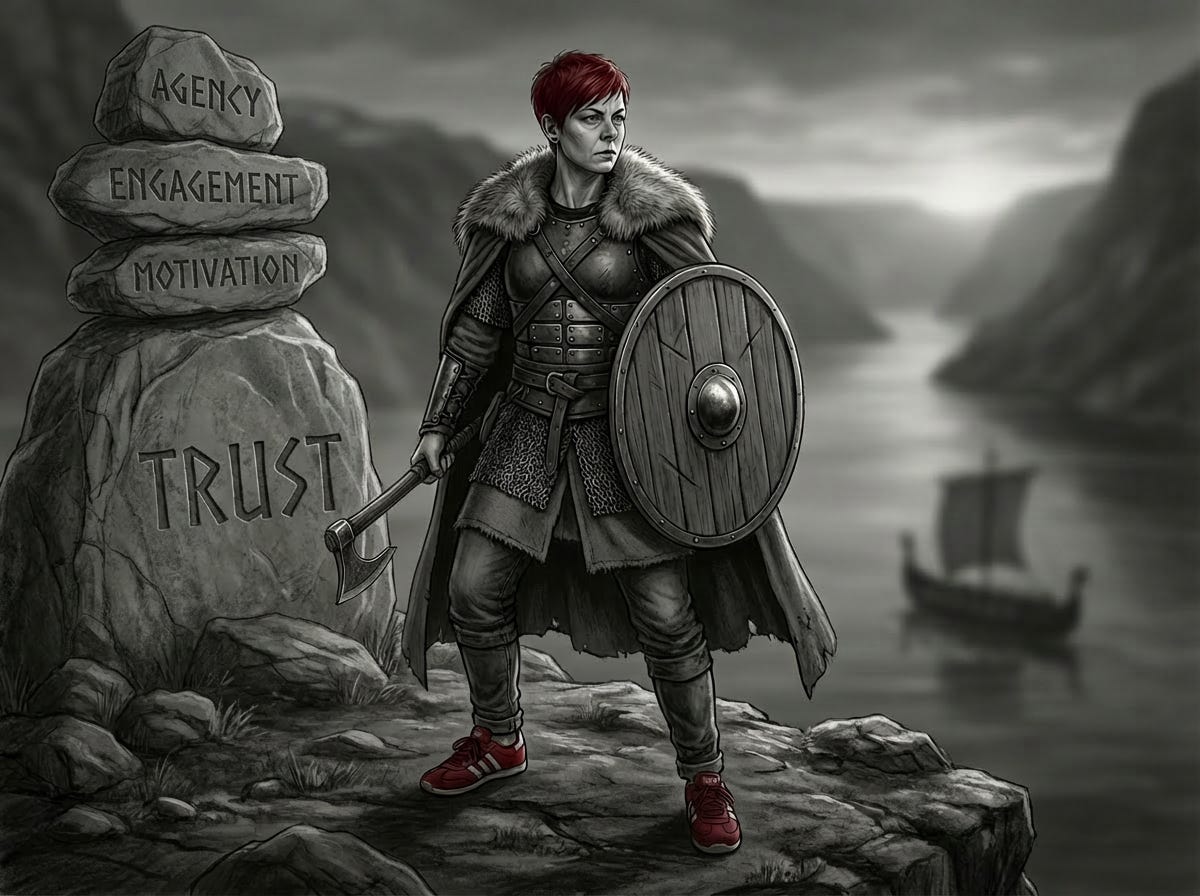
You can’t grant empowerment verbally
The gap between what you say and what they experience is where empowerment breaks down.
You can’t tell someone to feel empowered any more than you can tell them to “just be confident.” Empowerment isn’t granted through words—it’s created through systems, behaviors, and consistency.
Without clarity, trust, calibration, and safety backing up your words, “you’re empowered” becomes noise. They hear it. They don’t feel it. And the gap tells them everything.
Safety to be wrong
Trust without psychological safety is permission to succeed, but only if you don’t fail.
You can tell people they’re empowered, you can let decisions stand, but if they don’t feel safe being wrong, they won’t use the judgment you’re supposedly empowering.
I’ve watched this undermine empowerment more quietly than any other gap.
Someone makes a decision. It doesn’t go well. Not catastrophic, just not ideal. What happens next determines everything.
Remember that engineer with the estimates who got questioned behind his back? What did the team learn from watching that play out? Don’t give honest estimates. Give the number leadership wants to hear. Or pad everything because you’ll get questioned anyway. Or stop volunteering judgment entirely.
What it looks like when done right?
An engineer made a call to refactor a critical system during a feature release. It made sense technically but created timing risk. The release got delayed by a week. Not catastrophic, but not ideal.
The leader pulled them aside privately. Not to blame, but to understand: “Walk me through your thinking. What made this feel like the right call?” They explored the tradeoffs together. Turned out the engineer was optimizing for long-term stability but didn’t realize the business pressure on the timeline. Valid technical judgment, missing context.
The leader said: “Your instinct to fix this was right. Next time, let’s talk through timing tradeoffs before we commit. You still own this domain, and I want you to keep making these calls.”
Two months later, the same engineer faced a similar choice. This time they came to the leader first: “I think we should refactor this, but I know we’re under deadline pressure. Here’s the tradeoff. What do you think?”
They made the call together. The engineer learned. The leader stayed out of the way. That’s safety.
The team is watching what happens when someone gets it wrong. That tells them more about empowerment than anything you say.
When people feel like assets instead of humans
You can have perfect clarity. Calibrated involvement. Real trust in decision-making.
But if people feel invisible (or worse, like pieces you’re moving around a board), they stop bringing their thinking.
This shows up in small ways:
Someone makes a good call. You don’t acknowledge it. They see it.
Someone brings a thoughtful analysis. You skip past it to your own conclusion. They stop analyzing.
Someone takes initiative. It goes well. Silence. They stop initiating.
Someone raises a concern. You dismiss it. They stop raising concerns.
And it shows up in big ways:
You talk about people as “resources” or “headcount” in front of them.
You exclude them from decisions that affect their work.
They can’t challenge your approach or your thinking.
You treat their execution as valuable, but not their judgment.
You can repeat “be empowered” all day. If you don’t actually let them be empowered (if they’re excluded, dismissed, or talked about like assets to allocate), the words mean nothing. Nada. Diddly-squat.
What does it look like when someone feels their judgment matters?
An engineer raised a concern about the approach we were taking on a project. In a meeting, in front of the team. My first instinct was to defend the approach. We’d already decided, we were moving forward, raising this now felt like slowing us down.
I caught myself. Instead I said: “That’s a good question. Walk me through your concern.” They did. Turned out they saw a risk I’d missed. We adjusted the approach. I said in front of the team: “Thank you for pushing back on this. You saved us from a problem we would’ve hit later.”
What did the team learn? That challenging my thinking was valued, not tolerated.
Next meeting, someone else raised a concern. And another. We didn’t agree with all of them, but they kept bringing their thinking because they knew it mattered.
That’s what it looks like when people feel like thinking humans instead of managed assets.
What makes this real? Include people in decisions that affect their work before you’ve decided. Create space for them to challenge your approach, and actually listen when they do. Recognize good judgment out loud, not just outcomes. Ask for input before committing to direction.
Recognition isn’t a nice-to-have. It’s fuel.
When people feel their judgment matters, they bring more of it.
When they feel like managed assets, they shrink back to waiting for instructions.
When was the last time you explicitly recognized someone for good judgment, not just outcomes?
When empowerment breaks under pressure
I’ve watched this pattern repeat. Pressure arrives, empowerment disappears. A leader who normally steps back suddenly takes over, challenges everything, pushes their solution because it’s faster. The team notices and steps back.
One time, they might understand. But when it keeps happening, they learn the real rule: “You’re empowered... until things get interesting.”
That’s when empowerment becomes conditional, which isn’t empowerment at all.
And then there’s THE HERO move.
I touched upon heroes in one of my early essays, you might want to check it out.

Heroism comes in many forms, here are two of them: bringing in someone else to save the day, or doing it yourself. It feels like you’re helping, like you’re being a good leader by stepping in. You’re solving problems! You’re saving time! You’re also teaching your team that you’ll always take over when things get real, but that’s tomorrow’s problem. The pattern undermines what you’re trying to build.
What leadership actually looks like under pressure:
The team is struggling. Deadline’s tight. You can see the solution clearly, and it would be faster if you just took over.
Don’t.
Instead, ask: “What are you stuck on?” Listen to their answer. Often they’re not stuck on the problem—they’re stuck on a constraint they think exists, or missing one piece of context, or haven’t considered an option they don’t know is available.
Give them that piece. Not the solution, the piece they’re missing.
“You know we can push back on that deadline if needed, right?”
“Have you considered approaching it from this angle?”
“What if you didn’t have to worry about backward compatibility here?”
Then step back. Let them solve it.
If they’re truly stuck and time is running out, step in—but do it collaboratively. “I have an idea. Want to talk through it together?” Not “Let me just do it.” Work the problem together. Explain your thinking. Ask them to poke holes in it. Make it a learning moment, not a rescue.
Two examples:
A team was stuck on an architectural decision two days before a deadline. The leader could see the answer but asked instead: “What’s making this hard?”
The engineer said they were worried about scalability. The leader asked: “For the launch or long-term?” The engineer realized they were over-engineering for scale they wouldn’t need for months. They made a simpler call, shipped on time, and learned to ask that question themselves next time.
Another time, a team was genuinely stuck. The problem was harder than anyone realized. The leader stepped in but said: “Let’s work this together. I’ve seen something similar before. Tell me your constraints, I’ll tell you what I’m thinking, and we’ll figure out if my approach works here.”
They solved it together. The team learned. The leader didn’t become a dependency.
The hero gets short-term relief and long-term dependency. The coach gets short-term discomfort and long-term capability.
If you want real empowerment to survive pressure, protect it when it’s hardest. That’s the test: when it’s hard, not when it’s easy.
The calibration gap: Too much help, not enough help, never just right
Most leaders think empowerment is a scale from control to autonomy.
Less control = more empowerment.
Nope.
Both extremes prevent people from developing agency.
Too much control turns into micromanagement. People disengage because you don’t trust them.
Too little control turns into abandonment. People drown because you’re not providing the structure they need.
Effective empowerment isn’t maximum or minimum involvement. It’s right-sized involvement.
We leaders can miscalibrate both ways.
You won’t find this in your average empowerment advice book.
Not everyone is ready for empowerment at the level you think they are.
If team members have been fake-empowered for months or years (told they own things while every decision gets second-guessed), you can’t flip a switch one day and expect them to know what to do with real autonomy.
Empowerment requires responsibility and communication.
Without communication, trust erodes. When trust erodes, leaders pull back. When leaders pull back, people stop trying. A vicious circle.
You can set someone up for failure, then use that failure as proof that “people can’t handle empowerment.” Self-fulfilling prophecies are efficient that way.
A senior engineer was working on a very complex project. The leader thought: “He’s senior. He can handle everything.” Architectural decisions, writing the code, all the edge cases, dealing with the PM - all of it.
All good until it wasn’t. The project burned him to the ground.
Nobody checked in often enough with the technical challenges he was dealing with. He had to work in a new technology without much support from others. Then suddenly, after months of no pressure, came time pressure from senior management: this has to ship, ego in the game.
The engineer wasn’t used to this kind of freedom. He didn’t even want it. He felt abandoned, but he didn’t say anything. Asking for help felt like admitting weakness, like admitting he couldn’t handle it. He was introverted, kept everything inside, until it exploded.
The retrospective revealed he didn’t have good enough specifications, faced unreasonable expectations from the PM, and dealt with constant “Is it done yet? Is it done yet? Is it done yet?”
The leader thought this was empowerment. It was pure abandonment.
Senior title doesn’t mean someone wants - or is ready for - complete autonomy on a complex, high-pressure project with new technology and no support structure.
That’s not empowerment. That’s setting someone up to fail, then blaming them for it.
Right-sized involvement beats maximum or minimum
The goal isn’t to eliminate oversight. It’s about matching your involvement to the context.
I think about the person’s experience level, the task complexity, the risk level, and what breaks if this fails.
Junior engineers need more structure while staff engineers need strategic direction, not step-by-step guidance. Routine work gets less oversight, but novel problems need more collaboration. Low-stakes experiments get autonomy, while high-consequence decisions get structure. And I always ask: can we recover easily if this fails, or does this take down production?
Your involvement should change based on these factors:
Tighter collaboration early in someone’s growth, more independence as competence proves out.
More structure on high-risk decisions, less on low-stakes experiments.
Clear check-in mechanisms (not approval gates, but visibility and support touchpoints).
Explicit escalation paths (when to involve you, what triggers discussion, where to ask for help).
The goal isn’t to disappear. It’s to be useful.
Your team doesn’t want you to vanish. They want you to show up in the right ways, at the right times.
Hard enough to grow, safe enough to recover
Real empowerment means people can stretch without breaking.
When you calibrate involvement correctly, you create room for people to try things slightly beyond their current capability, with enough support that failure isn’t catastrophic.
This is where people actually grow.
Too much involvement leaves no room to fail safely. People can’t learn because you’re preventing mistakes before they happen.
Too little involvement lets failures become catastrophic. People lose confidence because they’re drowning, not stretching.
Right-sized involvement provides circumstances in which people can try, stumble, recover, and learn, with you close enough to prevent disaster but far enough to let them figure it out.
Hard enough to be real growth, safe enough to be recoverable.
When someone’s learning something new, I learned not to prevent all mistakes. I had to make sure the mistakes they made were the kind they could learn from, not the kind that destroyed confidence or broke production.
Not everyone wants maximum autonomy
This is the part most empowerment advice misses.
Some people can’t function without high levels of autonomy. They need to drive decisions, own outcomes, shape direction. Take that away and they disengage. I’m one of those people. I’ve always been.
But not everyone is.
Some people want clarity, structure, and defined boundaries more than they want autonomy. They want to know exactly what’s expected, execute well, and not carry the weight of ambiguous decisions. That’s a preference, not a weakness.
The mistake leaders make? Treating empowerment as one-size-fits-all.
Giving too much autonomy to someone who wants structure creates anxiety, not freedom.
Giving too much structure to someone who needs autonomy creates frustration, not clarity.
Calibration isn’t just about experience level or task complexity. It’s also about what the person in front of you actually needs to do their best work.
Ask them. Don’t assume.
Some people will tell you: “I want more space to make calls.”
Others will tell you: “I need clearer direction on what you want.”
Both are valid. Both deserve respect.
The goal isn’t maximizing autonomy for everyone. It’s matching the level of autonomy to what makes each person effective.
What real empowerment looks like
Empowerment isn’t one thing. It’s four things working together:
Clarity: Your team knows what good judgment looks like because you’ve defined success, constraints, and decision rights explicitly.
Trust: Your behaviors match your words. When you say “you own it,” your actions prove you mean it.
Calibration: Knowing when to step in and when to step back, based on the person, the task, the risk.
Safety: People can be wrong, learn from it, and try again without fear of punishment or invisibility.
When all four exist, empowerment becomes real instead of just words.
People make decisions without guessing, exercise judgment without second-guessing, and know when to escalate versus when to move forward. They bring their thinking because it matters. They take initiative because failure is recoverable.
That’s when you stop being a bottleneck and start being a multiplier.
The empowerment audit you won’t want to take
So how do you know if you’re actually doing this?
This is the self-awareness part. You know, the uncomfortable bit where you realize you might be the problem. My favorite.
Most leaders genuinely believe they’re empowering their teams. The patterns I’ve described? They’re not obvious from the inside. They emerge gradually, shaped by pressure and habits and the complexity of the systems we work in.
The first step is noticing what you might not be seeing.
I built a quick self-assessment tool with Lovable to help you spot these gaps :
Where to start
Pick the gap that’s costing you the most right now.
Missing clarity? List the 10 most common decisions in your area. For each one, define who decides, what constraints apply, what success looks like. Then share it. Make it explicit instead of assuming it’s obvious.
Behaviors don’t match your words? Find one decision where someone chose differently than you would. If it’s not wrong, ship it. Publicly support it. Make your trust visible, not just stated.
Miscalibrated involvement? Map your team by experience level and current projects. For each person, ask what’s the right level of involvement. Check in more where needed, step back where you’re overcorrecting.
People don’t feel safe being wrong? Next time someone makes a recoverable mistake, have a private teaching conversation, not a public correction. Recognize someone for good judgment this week, not just outcomes. When someone brings bad news, notice your reaction and adjust it. Give someone who stumbled recently another shot at something similar.
Empowerment isn’t about stepping back and hoping for the best. It’s about creating the clarity, trust, calibration, and safety that make good judgment possible.
I want a team so empowered, trusted, and supported that I can walk in with a business need or a problem and say: “Now do your magic.”
And they take it. Own it. Deliver it. And I’m proud of what they built.
That’s the dream.
But that dream has a lot underneath the surface.
It requires day-to-day communication that builds trust, difficult conversations when they’re needed, and support that flows both ways.
It means coaching through struggle instead of rescuing from it, being there for each other when things get hard, and solving things together.
It means not being too proud to ask for help, and not being too quick to jump in at the first sign of hesitancy. Sometimes people just need time to think things through.
“Just do your magic” still works. Turns out the magic was the systems we built along the way. (I had to. The setup was right there.)
But only when you’ve built the systems that make magic possible.
Your team doesn’t need permission to be empowered. They need you to create the conditions where empowerment is real.
Start with one gap. Fix it. Build the foundation.
Then eventually magic can happen again.