


The original MacGyver and the leadership myth we grew up with
I grew up on the real MacGyver from the 80s. The man could stop a reactor meltdown with a paperclip.
Turns out, that’s not far from life in tech and operations.

The MacGyver school of leadership
I bet every leader eventually goes through the MacGyver school of leadership. Those moments where you have no time, no perfect plan, and definitely not enough people. But you do have curiosity, resourcefulness, and that “there’s always a way” mindset.
The rush of the improvised win
And it feels great.
That spark when you suddenly see a path no one else spotted.
That jolt of momentum when the team jumps in with you.
That surge of “we’re actually doing this” as you stitch together the impossible with duct tape, cardboard, and sheer collective will.
That high from getting it done.
There is a real thrill in it.
It reminds you why building things is fun in the first place.
Where this mindset shows up in work and life, and the power of MacGyver people on a team
You see it everywhere: product, engineering, QA, scaling teams, even real life.
“Do what you can with what you have, where you are.”
I love having people like this on my teams.
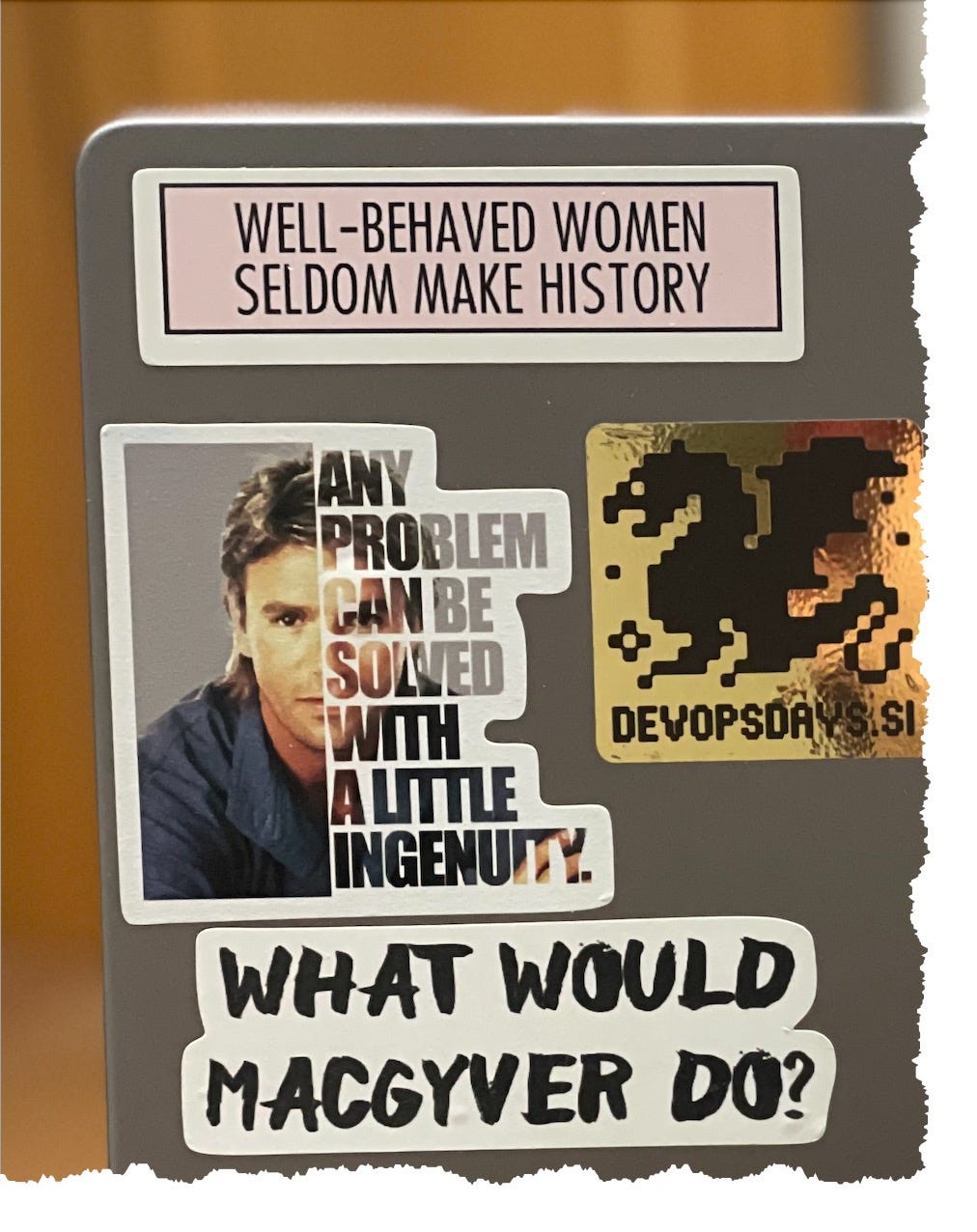
They unblock themselves. They get creative. They solve things others would escalate. Fun fact: I even bought “What would MacGyver do?” stickers for our QA team because that mindset genuinely moves things forward.
The catch: crisis solutions don’t scale
But here’s the catch.
The solution that gets you out of a crisis is not always the solution that will carry you into the future.
You can throw together an improvised aircraft from scraps, paper, and pure determination to escape a tough spot… but would you really put a hundred people on it for a weekly transcontinental route? Exactly. 😎
The scraps-and-paper aircraft problem
The danger is when MacGyver becomes the only playbook.
You start solving every problem with adrenaline and improvisation.
That is how good people accidentally earn a diploma as “firefighting arsonists.”
When improvisation becomes the only playbook
The real growth, especially as you scale, comes from knowing when to improvise and when to pause for a moment, step back, and understand the real problem you are trying to solve.
Not months of analysis. Just enough space to shift from reactive creativity to intentional design.
Because the world is disruptive, yes. But that does not mean every solution should be.
So how do you know when to stop MacGyvering and when to keep going?
What actually makes you pause before you MacGyver your way through the next problem?
…Or do you just keep MacGyvering everything because the pace is insane and AI already feels like it’s out to out-ship us all? 😅🤖
Here’s the simple lens I use, one that can save teams from burning out on duct-tape heroics and help leaders shift from reactive to intentional.
1. Is this a true crisis or a repeating pattern?
If it’s a one-off, go full MacGyver.
If it keeps happening, it’s not a crisis anymore — it’s a system problem wearing a crisis costume.
Rule: MacGyver the first time. Fix the system the second time.
2. What’s the blast radius?
Small, low-risk problem? Creativity wins.
Cross-team, high-impact, or customer-facing? Slow down. That deserves a real solution.
Resourcefulness is great. Gambling with reliability isn’t.
3. How tired is the team?
Improvisation burns cognitive fuel.
If the team is energized, hacks are fine.
If the team is fried, every hack makes things worse.
Crisis mode is not a culture.
4. Will this create more mess later?
A clever workaround that saves 30 minutes today but costs 30 hours next quarter isn’t clever.
If future-you would swear at this solution, rethink it.
5. Are you being the hero or the leader?
Leaders get stuck in MacGyver mode because it feels good, fast, and familiar.
But the real job is building a system where heroics aren’t required.
Ask: Am I solving the problem, or feeding my comfort zone?
6. Have you taken a 20-minute pause?
You don’t need months of analysis.
You need a short, intentional reset:
What’s the real problem?
What outcome matters?
What would a durable version look like?
Slow is smooth. Smooth is fast.
If you remember nothing else, remember this
MacGyver the urgent.
Design the important.
Never confuse the two.