


I’m on a stationary bike, watching a Coursera course on systems thinking while huffing and puffing like I’m training for the Tour de France I’ll never enter.
I bought a special standing desk for this setup. The font is cranked up to maximum because reading small text while pedaling is a recipe for motion sickness. I’m sweating. The course instructor is calmly explaining organizational dynamics while I’m trying not to die.
No one has ever sweated through a course on systems thinking as much as I have. Literally.
The Instagram version has better lighting and less sweat.
How cats stole my 5am hour
During the week, I get up at 4am. Sometimes 4:15 if I’m feeling generous with myself.
I used to be in the 5am club. That worked fine. Quality time with myself in the middle of the night when everyone would gladly label you as crazy. A cup of tea. A cup of coffee. Me and my book, my plan, my writing.
My husband gets up at 5:45. My son at 6. This gave me a solid hour of peace and quiet.
Then the cats joined our household.
Turns out, cats need 15-30 minutes of service before I can do anything else. They don’t want to read quietly together. They want to eat me. So I feed them, clean up after them, let them out, let them in, negotiate their various demands.
Before I turned around, it was 5:35.
I had two choices: give the cats away or get up an hour earlier.
I’m sure you can guess what I did.
Blessed be the morning hours when everyone is still asleep. Even the criminals.

Waiting for quiet that never comes
I love reading. Always have.
But here’s the thing: if I only read when I can sit down in quiet, perfectly focused conditions (other than in the wee hours), I’d be waiting for everyone to leave the house. Which, given that I live with other humans and demanding cats, means I’d read approximately twice a year.
Life is noisy. Time is fragmented. Attention is divided.
I could wait for everyone to move out. Or I could work with what I’ve got.
So I adapted.
I read on the couch while my husband watches Netflix. I listen to audiobooks while commuting, vacuuming, washing dishes, doing laundry. I draft essays on my Mac on the kitchen desk, one hand typing, the other folding t-shirts.
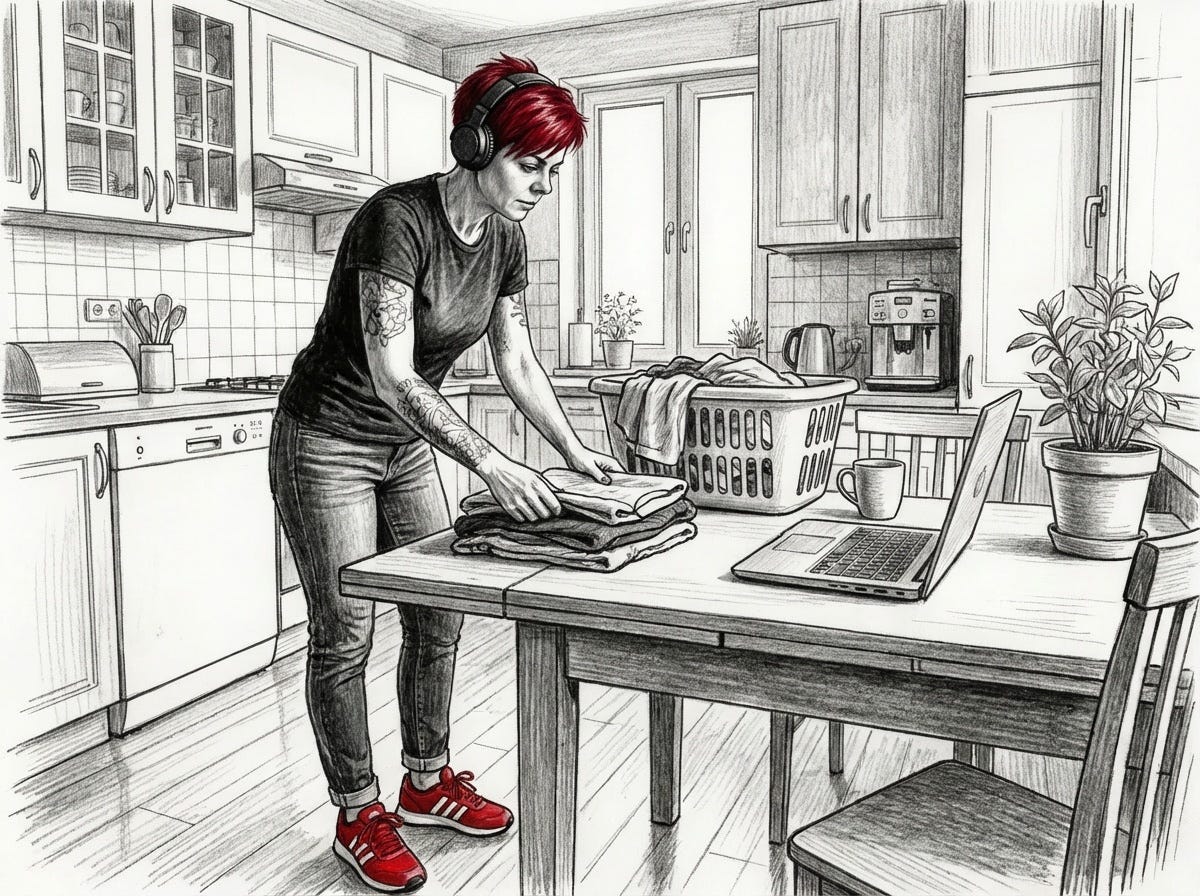
The result? I get to read almost every single day for at least 30 minutes. On weekends during chore time, often more.
It’s not weird in our house to see me or my son with headphones on, him vacuuming, me cooking lunch.
We’re not “being in the moment” with the chores. So what? I prefer reading over being present with my vacuum cleaner.
Funny thing: I always considered myself a visual person. Turns out I love audiobooks. There are even books I own in all three formats: audio, digital, and paper. Some I can listen to. Some I need to read, highlight, make notes in the margins. Some require all three passes.
I didn’t plan this. It just happened when I stopped waiting for ideal conditions and started grabbing learning wherever it fit.
Plot twist: there’s science behind this absurdity
I stumbled into this setup out of pure necessity. Turns out, I accidentally discovered what neuroscientists call “embodied learning.”
Which sounds way more impressive than “I learn stuff while doing chores because I have no other choice.”
Recent research shows that physical activity during learning doesn’t distract from cognition — it’s actually part of it. When you do simple physical tasks like chores while learning, you’re engaging multiple sensory channels (visual, tactile, auditory, kinesthetic), which creates stronger memory traces than sitting still at a desk.
Even better: simple repetitive tasks reduce cognitive load rather than increasing it. The brain doesn’t have separate systems for physical action and abstract thought. It reuses the same structures.
So when you’re physically moving while learning, you’re activating the exact neural networks you’ll need later for recall and application. Or, in less fancy terms: my brain works better when my hands are busy.
Translation: My ridiculous setup of sweating through courses while pedaling and learning organizational theory while vacuuming isn’t just a compromise. It might actually be better than the “ideal” conditions I thought I was missing.
Who knew that “being present with your vacuum cleaner” was overrated for more than just philosophical reasons?
The mental trophy case problem
For years, I thought consuming information was the same as learning.
I’d finish a book on leadership, feel smart, and move on to the next one. I’d complete a course and add it to my mental trophy case. Look at all the things I know!
Except I didn’t really know them. Not in any way that mattered.
Turns out you can’t just download skills like software updates. Shocking, I know.
The shift happened when I started treating my workplace like a petri dish for tiny experiments.
Read something about feedback loops? Try it in the next 1:1.
Learn a decision-making framework? Test it in a team meeting.
Discover a communication technique? Use it in the next project kickoff.
Small experiments. Low stakes. Real application.
That’s when I realized: reading gives you concepts. Experimenting gives you skills.
The audiobooks and courses I consume while doing chores? They’re the input. The microexperiments at work? That’s where the actual learning happens.
The unglamorous reality
Let’s be clear: this setup isn’t glamorous.
It’s:
Sweating through organizational theory while trying not to fall off a bike
Increasing font size to absurd levels so you can read while pedaling
Listening to the same audiobook chapter three times because you were too focused on not burning dinner
Owning the same book in three formats because different contexts need different approaches
Running tiny workplace experiments that sometimes work and sometimes flop spectacularly
It’s scrappy. Imperfect. Sometimes chaotic.
But it’s also real.
And it compounds. 15 minutes here. 20 minutes there. A micro-experiment on Tuesday. Another one next week. Over months and years, it adds up to something significant.
Not because the conditions were perfect. Because perfect was never coming, and I got tired of waiting.
Just show up sweaty
I’m not prescribing this as a method. I’m not saying everyone should wake up at 4am or sweat through Coursera.
But if you’ve been waiting for the right time to learn something, build a skill, or test a new approach, I’ll tell you what I learned:
Those perfect conditions I kept waiting for? They never showed up.
My life stayed noisy. My time stayed fragmented. My attention stayed divided.
So I stopped waiting.
Not just for perfect conditions, but also for perfect timing. You know what I mean — January 1st, first of the month, next Monday, after this project wraps up. We’re really good at inventing milestones that give us permission to procrastinate.
Turns out January 17th works just as well as January 1st. So does April 5th. Or July 28th. Or December 30th, for that matter.
The date isn’t magic. Starting is.
If you need that fresh start feeling, just tell yourself “Happy new personal year” on whatever random Tuesday you happen to be reading this, and begin.
Audiobook on the commute. Reading on the couch. Listening while doing chores. Drafting while folding laundry.
Then a tiny experiment at work. One thing. See what happens.
The 4am learning club doesn’t have membership requirements. No fees. No expectations. No judgment about how unglamorous your setup is. You can even start it at 7am, if this is your 4am.
You just show up. Sweaty, distracted, doing three things at once.
The cats are optional, but they do add a certain level of chaos that keeps things interesting.
Welcome.
You're so right about the context switching and related multitasking thing. I used to think all of it was bad until I realized my brain doesn't treat "listening while driving" the same as "trying to code while someone's talking at me." One works, one creates a pileup.
The bigger thing I've noticed though: it's less about squeezing more into the day and more about figuring out when I actually have energy to absorb things. Some tasks drain me. Some are just... neutral. Learning during the neutral ones isn't compromise, it's just paying attention to when my brain is actually available.
Sounds like you cracked that code with the commute podcasts. Sometimes our brains actually work better when we stop trying to force them to sit still.