


Teams are finished. Everyone gets AI agents, managers become overhead, leaders become optional, and the organization flattens into highly productive individuals who somehow coordinate themselves. The future in this story has suspiciously few meetings in it.
At first, I treated those predictions the way most people do: another hot take, another confident forecast, another argument about a future nobody has lived in yet.
Then Elena Verna published IC work is the new career flex, and it was the last drop.
It wasn't the essay per se. I don't think she's wrong, quite the opposite: I read Elena because she often sees around corners before the rest of us do, and that piece was her telling her own story about moving back to individual work. It wasn't a manifesto about anyone else's organization, but from where I was standing, it read like one anyway.
What got to me was what happened around it. Some people near me took from it something much shorter and blunter than anything she wrote: we only need ICs now, leadership doesn’t matter.
I finished her article, looked at my draft I had open for this newsletter, and caught myself thinking: Why would this even matter?
I hadn’t stopped believing that teams matter. I had started wondering whether writing about them still did.
I didn’t stop writing. Just publishing.
For the next couple of months, I kept opening drafts, adding a paragraph here, deleting one there, then closing the document again. One of them is still sitting in a folder from the beginning of June.
Page 2257
Then Elena published Please stop the AI Confidence Theater, followed a few days later by So, you want to be a content creator?
The first one told me I wasn’t the only one reading all that confidence and wondering whether I was the crazy one. The second reminded me why I started this newsletter in the first place.
She wasn’t twisting anyone’s arm into writing. She just got me out of the funk by reminding me why I write, the way I write, and what I write about.
Around the same time, I was reading a box set of crime thrillers on holiday. Fourteen books, Hawaii, vigilante justice: the literary equivalent of comfort food. (No regrets.) On page 2257, Toby Neal wrote:
“Life is all we have. Time is all we have. How is it of any benefit if we are living in the past, or projecting into the future? If we squander these precious moments with bitterness, judgment, or regret?”
Not where I expected to find the useful part, but there it was.
Between Elena’s essays and one paragraph in a thriller, I finally noticed what I had been doing.
Ten very productive islands
I had skipped this question for two months: are the predictions actually right? So I did what I usually do with a conclusion I don't like — I tried to prove it.
Every version of the argument I've read points out the same thing: how much one person can produce. Better tools make everyone faster, AI lowers the cost of writing, coding, analyzing and designing. Fair enough. But how much people can produce and whether any of it adds up to something coherent are definitely not the same things.
Ten highly capable people, each working with a handful of AI agents on ten separate islands, are ten very productive islands. Still islands, though. The bridges between them were not unnecessary overhead, they are how separate pieces become one product, how one team’s decision doesn’t become another team’s incident, or at least does it less often, and how somebody notices that three individually sensible choices make no sense together.
I’ve rarely seen a team fail because people weren’t producing enough. I’ve seen plenty produce in five directions at once, and some leaders are easily impressed by speed, never mind which direction. Much wow, much progress.
Most organizations still can’t reliably pass a decision from the room where it was made to the people who have to act on it. Capability problem? I don’t think so. Also, no amount of individual productivity touches it. We haven’t solved information sharing with a layer of people whose actual job includes moving information around, so I’d like to hear the plan for what happens when that layer is removed. Must be black magic.
Most of us are B players
There is a version of this future that works, and it belongs to superstars. The people writing the forecasts are exceptional almost by (their) definition, and they’re describing a world built for people like them.
Most of us are B players compared to them. I’m not trying to be self-deprecating, it’s just what the word means. But Moneyball was never a story about stars. It was about working out what ordinary players are actually good at, then building something that gets more out of them than they’d manage alone. That’s a team. And if that’s right, the rest of us have a place in this future too. Probably not the glamorous one. I don’t mind.
A group of agents is a toolchain, not a team. Someone has to notice when they go rogue and do the ordinary work alongside them the rest of the time. The pitch you keep seeing is build and forget: you set it up, it runs, and you sip piña colada somewhere, worry-free.
Last time I checked, agents need other agents to keep them in check, human or otherwise. Someone has to run them, update them, and clean up after them, if not today then the day after tomorrow, and unless the plan is to hire ghosts, that someone is a person. I’d hold off on the piña colada for now, because someone still has to play Neo to keep all the Agent Smiths in line.
And once you have more than one of those “someone” people, working on something complicated enough that the goal isn’t obvious, you’re back where you started. Somebody has to set a direction, keep the effort pointed the same way, and get the group to trust each other enough to disagree in public. Remember the decision that never makes it out of the room? Guess what, that doesn’t just go away because half the coworkers are software.
Sure, some of the predictions will come true, but others won’t. One and two-person companies are real, and some of them are doing remarkable things with a stack of agents behind them. I’ve never worked in one, and short of starting my own, I’m not likely to: a company that runs on one or two people isn’t hiring a third. What I haven’t seen is one of them at fifty people, still with no teams and no one holding the direction.
So the question is not whether you can work without a team, it’s how long you can. The prophets call it truth. I call it a dare worth taking.
Grieving in advance
Winning that argument didn’t help. What bothered me was how much influence I had already given the prophecy.
Prophecies become facts through repetition. One person predicts, another summarizes, a third writes about the implications, and before long everyone is discussing the consequences of something that hasn’t happened. By month three it has a name and by month six, a conference track. Yay!
Somewhere in that repetition, I stopped asking whether the prediction matched my experience and started asking whether my experience still mattered. The mistake wasn’t reading the prophecies or taking them seriously, but treating them as settled fact and grieving in advance.
Meanwhile the work kept happening. People still disagreed, teams still got stuck, and someone still had to notice the misunderstanding before it became an expensive problem.
Where the prophets have a point
They aren't wrong about everything. A surprising amount of what passes for teamwork today is coordination overhead we created ourselves, and some of it deserves to disappear.
I’ve never worked somewhere big enough for the middle to become a layer of its own, where people are placed between the top and the bottom so the top doesn’t have to talk to everyone below, and where that layer is thick enough to stop the whole place from moving. That is real for some people, and the case against it is stronger than anything I’d build from where I sit.
If you were managing people and not much else, and the title mattered more than the work, this will be uncomfortable. Delegating to people is a skill you spent years building. Delegating to agents is a different one, and there isn’t much time to unlearn the first and pick up the second. And if you’re lucky enough to work somewhere the information already sits semi-structured in documents somebody keeps current, reconsider your options. This is exactly what AI is good at.
Individual capability is climbing fast enough that fewer people will be needed for some kinds of work. Teams may become smaller. Some layers will disappear, and some jobs whose value depended on information moving slowly will become difficult to defend.
My own work hasn't changed much. I've been doing IC work and leading for years, and what changed is which one I'm supposed to show. The advice used to be you need to be more strategic, get out of the trenches, get some (business) perspective, so I kept the IC part out of the spotlight. Now the same people tell me the earth is flat, or possibly one huge trench for ICs to work in, and looks like the (business) perspective will automagically arrive by osmosis, in everyone's sleep, from all that context they still aren't sharing.
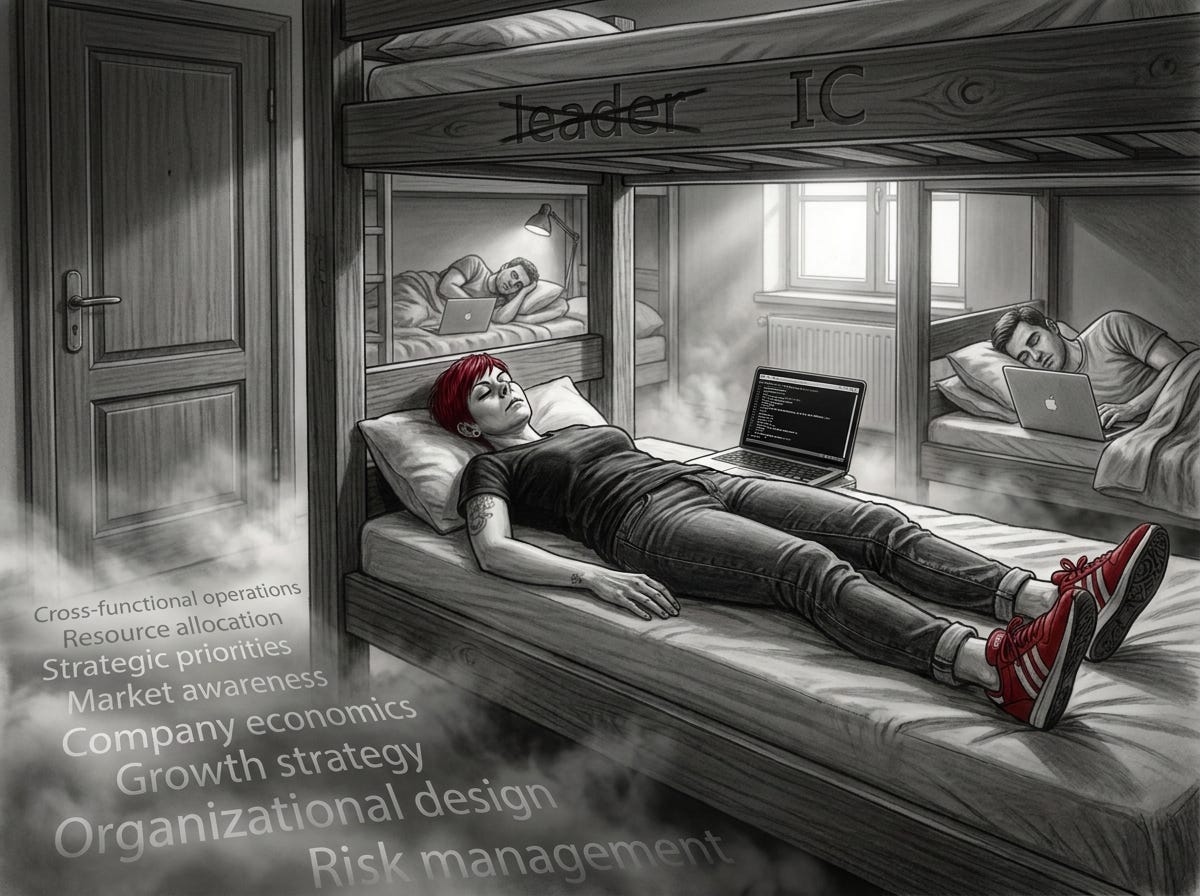
Rigid process, formality that exists because it has always existed, approval chains nobody can explain: I can’t stand it. It smothers whatever’s creative in a room, and I have never enjoyed being inside it.
But I’ve lived the other version too, where nothing is really decided, everything is improvised, and the organization runs day to day on whoever spoke most recently and most loudly. That isn’t freedom either. It looks like a duck, it quacks like a duck, and then you look closer and it’s a trojan horse: the coordination cost didn’t disappear, it moved onto whoever cares enough to absorb it. Usually the same two or three people and I’ve been one of them.

Removing unnecessary coordination still isn’t the same as removing the need for coherence. AI produces more answers than I can read. It still can’t tell me which argument the team needs to have this week.
Not the crazy one, then
I don’t know what organizations will look like five years from now. Nobody does.
I know what one of them looked like this morning, because I was in it. People misunderstood each other, avoided the difficult conversation, optimized for different things without noticing, and then solved something together that none of them would have managed alone. If that stops happening, I'll write about that instead.
Until then, I’ve got material.
So: enough sitting in the self-pity, sleeves up, back to writing. I mostly do this to clear my head, which is a less impressive reason than predicting the future and a considerably more honest one. I’m not writing only for subscribers either, though I’m grateful for every one of you.
And if you’re somewhere similar, reading all that confidence and quietly wondering whether you’re the crazy one, and something here helped: we’re crazy together. Or everyone else is. Right?
The thing between the chair and the computer
Later in the same book, Toby Neal wrote:
“To truly master yourself you must first see yourself clearly, and then completely and totally accept yourself as you are. There is no other true baseline for growth.”
I’d spent two months doing the opposite: wondering whether I should become another kind of writer, someone who prophesies instead of describing what’s actually in front of them.
I’ll keep writing about AI. It’s changing my work the same way it’s changing yours, and pretending otherwise would be strange. But the people, the culture, and everything else that depends on the thing between the chair and the computer stay front and center. That’s what I keep coming back to, and what I understand best: the conversations that never happen, the misunderstandings that repeat, the incentives people stop seeing because they’ve lived with them too long.
And if the prophecies land and all of this really does go obsolete, I don’t even need to rewrite anything. I’ll just file the whole thing under fiction. Crime fiction, if I’m lucky: my detective solves the case by page 40, then spends until page 2257 trying to get the decision out of the room.
The part that stayed with me is "prophecies become facts through repetition." One person predicts, another summarizes, a third writes about the implications, and suddenly everyone is managing the consequences of something that never happened.
I spent twenty years in an industry that's currently doing exactly this to itself — grieving in advance for its own relevance, chasing a forecast instead of the work in front of it. What I keep noticing is that the prophecy doesn't just predict the future. It quietly rearranges the present to look more like itself. People start acting as if it's already true, and the acting is what makes it true.
Your islands metaphor gets at the thing nobody wants to say out loud: production was never the bottleneck. Coherence was. Ten brilliant answers I don't have time to read don't add up to one
decision the group actually needs to make.
Filing the whole thing under crime fiction if it goes obsolete is the best line I've read this week. The detective solves the case by page 40 and spends until 2257 trying to get the decision out of the room — that's not a joke, that's most of my working life.