


I’m sure you know what it feels like to expect one thing and get something entirely different. In our personal lives, that mismatch is annoying or frustrating, but at work, it can quietly shape trust, momentum, and how a team experiences its leader.
That gap between expectations and reality is something every leader has to manage, whether they realize it or not.
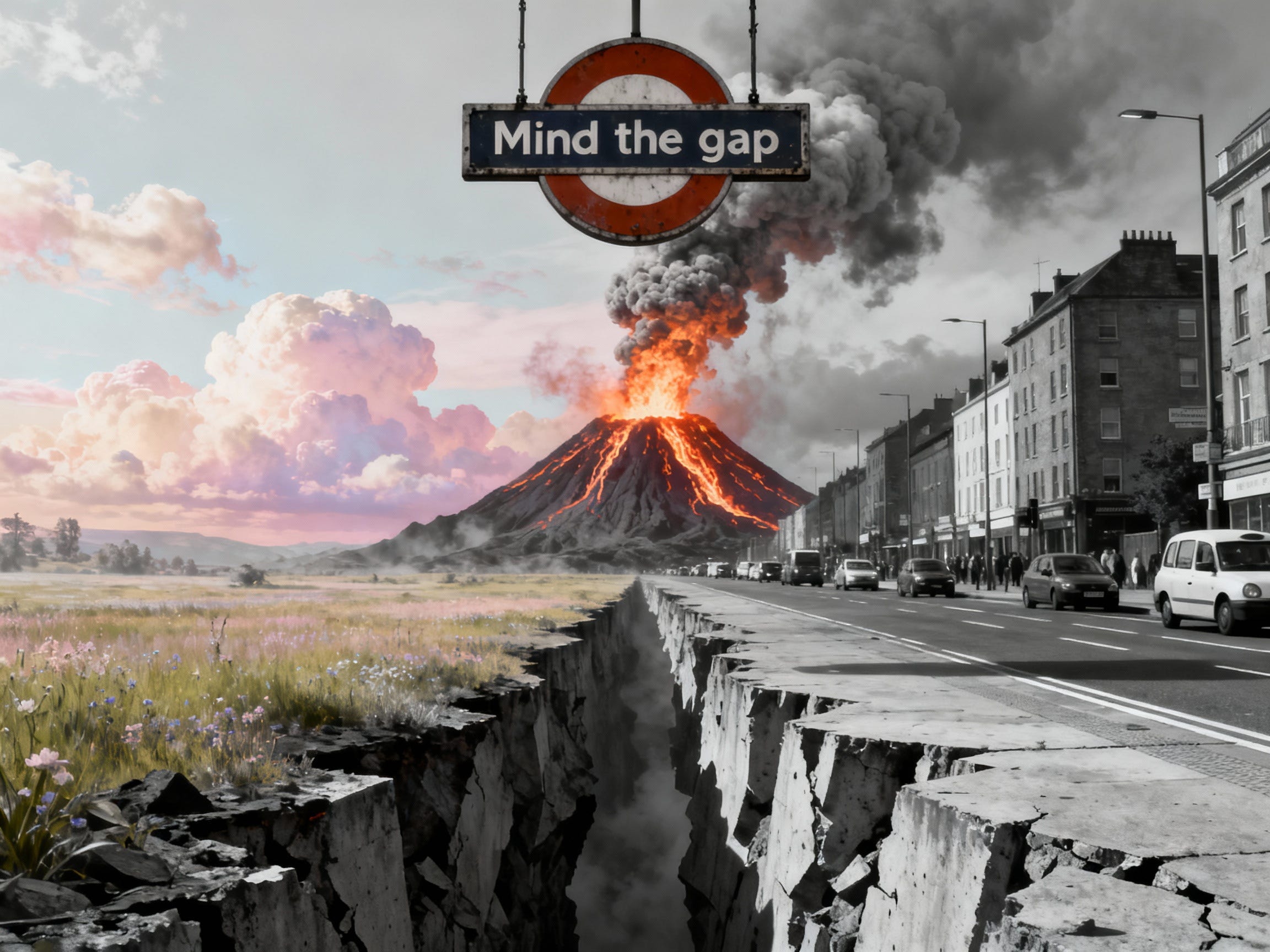
I learned this in an unexpected way, with a volcanic eruption in Iceland playing an unlikely supporting role.
Yes, really, a volcano. But that part is the twist, not the lesson.
The setup: burnout in slow motion
I was a teaching assistant at the university then, enthusiastic, well-meaning, and genuinely invested in my students. Caring came easily. Boundaries… less so. I was still learning where the lines between commitment and overextension actually were.
At that point, my workload had already climbed to 32 hours a week in the classroom (instead of the usual eight), plus another 40+ hours of preparation, grading, and covering the gaps created by hiring freezes. Every week, for almost a year.
I had over a hundred students across different classes, and I was also covering my mentor’s portions because he had competing responsibilities elsewhere.
Like many enablers, I carried the workload because someone had to — and because I cared.
When things finally became untenable, I asked for help. Repeatedly. The answer was always some variation of “There’s nothing we can do. Just push through a bit longer.”
Spoiler: that’s not a strategy. Not for you, and certainly not for your team members.
So when I was offered the opportunity for a month-long exchange in Bergen, I was already quietly burning out. I initially resisted, but my superior framed it as an opportunity I “shouldn’t miss.” He even pitched it as a mini vacation where I could finally rest and regenerate. And because I desperately wanted that to be true, I let myself be cajoled into saying yes.
With that level of exhaustion already in the background, I headed to Bergen. And almost immediately, reality made sure I learned one of the most valuable lessons of my life.
The crash landing
A week before departure, I developed a sharp pain in my lower back, not from an injury, but, as I now know, from stress finally demanding its toll. Then, on the flight to Bergen, I fell asleep with my head against the window and woke up unable to hear in my right ear. If you’ve never experienced sudden hearing loss, it completely wrecks your balance and orientation. It certainly wrecked mine. Yay.
I landed in Bergen barely walking, disoriented, carrying heavy luggage, sleep-deprived, and starving… not exactly the “mini vacation” I’d been promised.
My temporary boss met me at the bus stop and walked me across town to the apartment I’d be staying in. Only when we arrived did she realize she’d forgotten the key. We had to go back to her office at the university (she didn’t have a car), a long walk away on the opposite side of the center. So off we went again, luggage, back pain, hearlosss and all, through a city I couldn’t yet navigate and with a body that was already protesting every step.
When we finally reached her office, she handed me the key, announced she needed to get back to work, and assured me I’d “find my way just fine.” Then she added, almost casually, that we’d be working the entire weekend. The. Entire. Weekend.
Boom. Just like that.
The sense of despair crept in. What was framed as a breather had suddenly become a different flavor of overwork.
I turned around and started retracing my steps. But with despair in my mind about the looming weekend work, the hearing loss, the fatigue, and the uncanny sameness of Bergen’s wooden houses, I wandered in circles for nearly an hour. Eventually, my body gave out. I found a small park, sat down on a bench, and cried — not because I was weak, but because the reality in front of me was so far from the story I’d been sold.
That moment on the bench was the true crash landing.
The lesson
Sitting on that bench, I had every reason to blame the situation: the pain, the hearing loss, the hunger, the luggage, the overwork, the forgotten key, the endless walking. But none of those were the thing that truly broke me.
What broke me was the gap.
The distance between what I expected and what reality delivered.
I’m tough. I’ve duct-taped my knee at kilometer five of a forty-kilometer trek and finished it. Physical strain doesn’t scare me. But misalignment — expecting one thing and getting its opposite — can shake even the strongest of us.
That moment forced a clarity I had avoided for months.
What I realized that day is something I’ve carried into every role since: when there’s a gap between expectations and reality, something has to give.
Sometimes we soften our expectations. Sometimes we start changing our (future) reality. Most often, we begin by naming the mismatch so it stops growing quietly in the dark.
Bridging the gap is rarely one dramatic move. It’s a series of small recalibrations, honest conversations, and remembering to focus on the things we can actually influence.
I had two choices:
Cling to the story I wanted this trip to be, and keep suffering.
Accept the reality in front of me, recalibrate, and act from there.
I chose the second.
Not because it was inspiring or brave, but because it was the only way to regain any sense of control. I needed to see the situation for what it was: not good, not bad, simply real, and respond to that instead of the version I had hoped for.
Once I did, the next steps were quite obvious.
I stood up, found a small hotel nearby, asked for a map, and finally located my apartment. It turned out I’d been circling it. The rows of wooden houses all looked the same to my disoriented, half-deaf brain.
I spent the following weeks working Monday through Saturday, adjusting to the hearing loss, and finding small pockets of restoration: Pratchett’s Discworld books at night, slow hikes on Sunday afternoons.
The workload didn’t change. But my relationship to it did.
Recalibrating my expectations didn’t make the situation easier, but it made it manageable. It brought me back to myself.
I learned the lesson that leaders often learn only in hindsight:
When you don’t manage the gap between expectations and reality, reality will manage it for you — usually in unpleasant ways.
Volcano to the rescue
By week four, I had settled into a rhythm. Not a healthy one, but a functional one. My boss was scheduled to travel to Belgium for a few days, and I was looking forward to at least having my afternoons to myself.
Then something entirely unpredictable happened.
Eyjafjallajökull, a volcano on Iceland, erupted. It was in April 2010. Google it.
The ash cloud grounded flights across Western Europe, Belgium included. My boss couldn’t return. Suddenly, the weekend work evaporated. For the first time in months (or even longer), I had uninterrupted space and time for myself. Two full weekends with no obligations, no frantic scrambling, no one needing anything from me.
Just quiet.
In the next two weeks, back pain disappeared without a trace. Hearing was slowly returning day by day, and my sense of humor reappeared.
The volcano didn’t teach me the lesson. I’d learned that on the bench.
But the volcano did something equally important: it created the space for the lesson to settle. For me to reflect. For my system — mind, body, nervous system — to stop bracing long enough to see my life clearly.
In that space, I realized just how unsustainable everything had become. And once I saw it, I couldn’t unsee it. A couple of months after returning home, I left the university job, joined a startup, and never looked back.
Sometimes disruption destroys.
Sometimes it clears just enough space for you to rebuild.
Why this matters for leaders
What I lived through in Bergen wasn’t just burnout. It was the tipping point of the cumulative effect of a widening gap, the space between what I expected and what was actually happening.
And that gap is something every one of us has to manage in our lives.
But at work, leaders shape it the most: teams don’t break because of hard work, they break because of misalignment:
when expectations are unclear
when the story shifts, but no one names it
when people are told “just push through” instead of getting support
when the reality they live doesn’t match the one they were promised
That’s where trust erodes, that’s where morale slips, and that’s where burnout takes root.
Leaders don’t cause every mismatch, but they influence how big the gap becomes and how people experience it.
Managing that gap intentionally means:
communicating what’s real, not what’s ideal
updating expectations when the situation shifts
reducing ambiguity before it turns into resentment
supporting people through the emotional load that comes with change
creating psychological safety by saying what others only feel
When leaders do this well, teams stay anchored, even in uncertainty, but when leaders ignore it, people end up doing what I did on that bench in Bergen, carrying the weight of misalignment alone, right up until the moment they can’t anymore. And that’s when they disengage… or they leave.
The lesson I learned there wasn’t about resilience. It was about reality, and the importance of acknowledging it early, often, and without shame.
Because when leaders don’t manage the gap, the gap will manage the team.
Mind the gap
I could easily share a dozen workplace stories where the gap between expectations and reality took its toll: moments I’ve observed as a leader, a peer, or simply someone standing on the sidelines watching people navigate misalignment they didn’t create.
But instead, I chose to share this story, my story, because occasionally the lesson lands more clearly when it comes wrapped in something unforgettable.
And, well… not every leadership insight comes with its own volcano eruption.
The truth is, the gap doesn’t go away on its own. It widens quietly until someone names it, bridges it, or breaks under it.
We can’t prevent every mismatch. But… we can choose to notice it sooner, we can recalibrate with intention, and we can create environments where people don’t have to sit on a bench, literal or metaphorical, trying to make sense of a reality they never expected.
A volcano won’t erupt every time your expectations crumble.
(Thankfully.)
We can learn to mind the gap long before the ground starts to shake, because expectation management isn’t a soft skill, but a leadership survival skill for us, and for the people who trust us to lead.
So… mind the gap.
Mini leadership playbook on how to manage the gap between expectations and reality
1. Name the gap early.
Most frustration comes from the space between what people **think** will happen and what actually unfolds. Call it out before it becomes emotional debt.
2 Don’t overpromise clarity you don’t have.
Uncertainty is easier to handle when leaders say, “Here’s what we know, here’s what we don’t, and here’s when we’ll revisit it.”
3. Translate strategy into lived experience.
Teams don’t work inside presentation slides. Spell out what decisions mean for their day-to-day reality: workload, priorities, trade-offs, pace.
4. Reset expectations as reality shifts.
Priorities move. Timelines slip. Context changes. The faster you recalibrate expectations, the less trust you lose.
5. Be explicit about what won’t happen.
Clarity isn’t only about what’s included. It’s about ruling things out so people don’t fill the gaps with their own assumptions.
6. Watch for emotional indicators.
Silence, sarcasm, impatience, withdrawal: these are early signs that the gap is widening. Address the feeling before the project.
7. Model recalibration yourself.
When you normalize adjusting expectations without shame, blame, or drama, you give your team permission to do the same.
8. Reduce the gap, don’t close it.
Perfection isn’t the goal, alignment is. Your job is to shrink the distance so people can operate with confidence, even when conditions aren’t perfect.