


“Hope is a fickle, dangerous thing. It steals your focus and aims it toward the possibilities instead of keeping it where it belongs - on the probabilities.”
Rebecca Yarros, Fourth Wing
This quote has been on my kitchen whiteboard for a while now, and I see it multiple times a day. It’s advice the heroine, Violet, gets when she asks about her chances of survival in a brutal, unforgiving world full of dragons and danger: she wants comfort, or at least a straight answer, and she gets corrected instead. Stop hoping. Start calculating.
What’s so special about this quote? Apart from being from an interesting book involving dragons, fears, overcoming vulnerabilities and playing on your strengths? I read texts on positive psychology (kudos to Seligman), hope and meaning in life (wave at Frankl) and at first sight it looked like this quote wanted me to say “abandon hope all ye who enter here”.
But does it really? Of course not. Let’s take it apart.
I think it had the same effect on me as it had on the heroine, minus the dragons. I keep thinking about what AI is doing to every SaaS company, and to everyone working inside one. Bosses demanding more for less, because they can, customers requiring more and easier for less, because they see it elsewhere... or they’re even doing things themselves where before they had to rely on (companies like) us. Everyone’s job description will change shortly if it hasn’t already. We can’t pretend changes are not happening... it’s more about how soon and how deep.
I’m a realist and I see and feel all this, and while I secretly (romantically) hope for the best, I also know the probabilities don’t care much what I hope for.
The quote made me think about how I’m dealing with the world I live in now and it had me wondering whether it’s a time for hope, or a time for math.
Math. That’s where I started, anyway.
What would Viktor Frankl say?
You probably heard about Viktor Frankl at some point (if you haven’t, please google him). My brain works in a peculiar way, nothing super special, just connecting the dots from different things I read and learn.
So, Frankl survived the WWII concentration camps and wrote that “the sudden loss of hope and courage can have a deadly effect.” He meant that literally; he was writing about immunity. How can I just abandon hope, if it’s the thing that kept people alive during a gruesome time in the camps?
Of course, my own stakes are nowhere near Frankl’s personal experience or Violet’s fictional one, and yours probably aren’t either. Hopefully (pun intended) nobody’s job is a camp, and nobody’s regular workday is a bloody and cruel fantasy novel. But I have choices, things I can prepare for, actions that can improve the odds.
Violet’s odds in the novel are bad (she is short, with bad joints and facing intense physical and mental challenges), but they are odds, the kind you can train for. On the other hand, Frankl’s camps offered no freedom and no agency to change the circumstances. The people in them had control only over their minds.
So, realistically, some situations you can prepare for and some you can’t, and hoping your way through the first kind is where people get hurt, in a novel and, it turns out, also in a market.
Here be dragons
Yarros’s book has dragons. So did old maps1, out past the edge of what anyone had charted, because dragons look way better than the letters TBD.
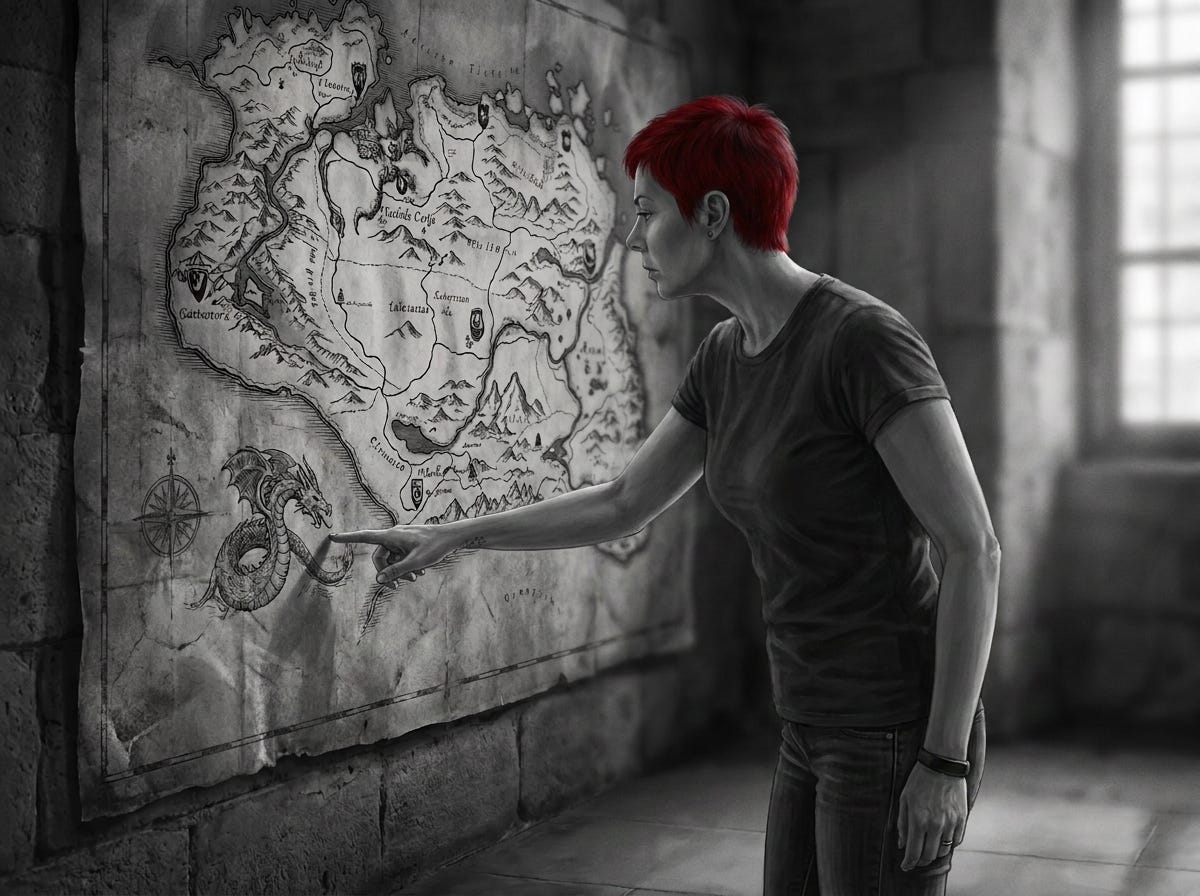
Today, this uncharted part of our map is the equivalent of the AI section of most company plans (ad-hoc or not), and of the confident (data-driven) posts about agents. We only started exploring these new parts, and the people who claim to know everything about what agents will do to your job haven’t seen the whole map either, so whether they’re selling the panic or the reassurance, I’m not willing to take their word for it.
So what exactly sits past that edge? More than the tools. An engineer is working out which half of the craft still counts. A team lead has to say something in a 1:1 that isn’t a lie. The people closest to the customer are watching the thing they’re best at get cheaper every quarter.
Nothing has moved this fast before, so there’s no earlier cycle close enough to borrow from. Ask anyone for a timeline and you’ll get something between eighteen months and yesterday.
The charted part of the map keeps growing, and we’re the ones drawing it. Every time you work out what an agent actually does well, what a run costs, where it quits on you halfway through, you put that on the map. It turns up in a post, somebody disagrees in the comments, and the map gets a little bigger. Less thrilling than a prediction about eighteen months from now, and much easier to calculate odds on.
Just so you know, not all dragons are bad. In Yarros’s book people ride them, and whoever gets one spends the first stretch terrified and useless on its back, which turns out to be part of the training. (If you’re intrigued, read the book.)
The dragons might not eat you. Know what? You might end up flying one, and if you do, strap yourself in.
Don’t grow a mustache in the meantime
Are you waiting for someone else to explore and chart the map for you? You could grow long hair and a mustache in the meantime, and it still wouldn’t stop anything from happening. More layoffs? Roles changing? Already happening, whether any of us likes it or not.
Underneath is a fear I think a lot of us carry around without saying it: what if my role disappears, or what if the company doesn’t make it,... or what if the thing I’m good at stops being the thing anyone pays for. Saying that out loud doesn’t make you the doom and gloom person. On the contrary, it takes some nerve to look at a possible future straight on. But not looking at it, pretending it’s not here, or telling yourself I’m fine, everything is fine? That’s just old-fashioned wishful thinking that somehow everything will be just fine.
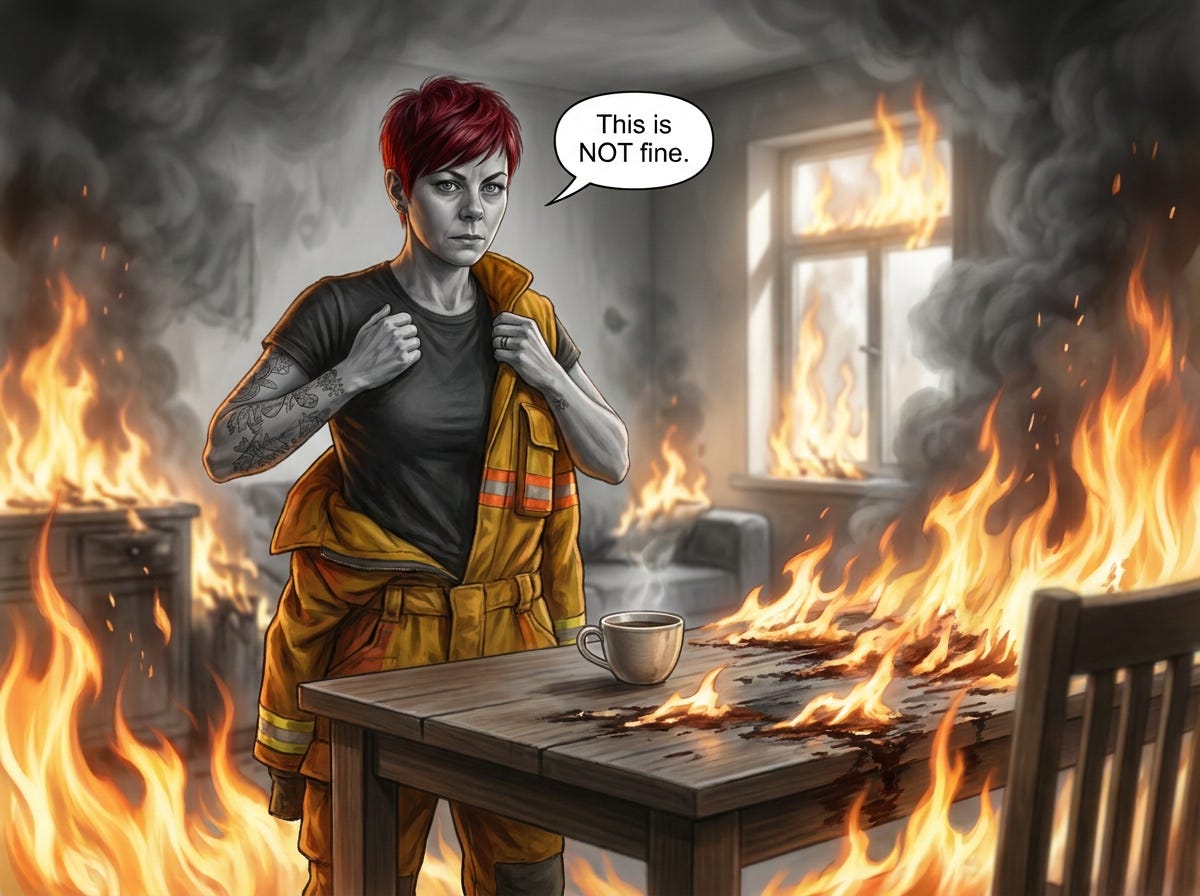
I understand the instinct to wait for leadership to work it out first. That’s how it has worked for years, and most of us got rewarded for going along with it: somebody senior reads the market, sets a direction, the rest of us execute against it. It’s a reasonable habit and it’s been a safe one.
It also assumes they’re holding a map the rest of us can’t see. They might have had one before, they sure don’t now. They’re on the same map we are, they just might have the advantage of standing on a small hill. And nobody on my team should be waiting for me to hand them one, the same way I’m not waiting for the exec above me.
So instead of waiting, let’s flip the perspective.
What can I do as a leader of one (me)?
Do I have an idea worth trying? And if nobody listens (it happens), can I at least come out of it having learned something? Sure, this takes a bit of courage and much more brain energy, but it increases the odds.
What’s still ours, no matter what our company decides this quarter (or month), is our plan.
I don’t mean “what’s our five-year plan” type of plans, they don’t stand the slightest chance in contact with reality. A month will do, for now.
I’m talking about what we’re building right now that stays ours: what we can do, what we’ve made, who knows our work outside the reporting line. None of that changes when the company changes its mind about AI.
SaaS is getting hit early, and if your industry hasn’t been yet, you have more time than I do. Use it.
So, here’s part of my own math, out loud. AI doesn’t care about my leadership skills. Agents don’t behave the way people do, not quite, and managing them isn’t going to be the same job as managing a team. What are the odds I’m running a hybrid team, people and agents, sometime soon? Very high. So what can I do about that?
I can learn agent loops, what rules and skills actually do, how harness works. I can build my own agents at home, which is how I find out how they behave and what it takes to orchestrate more than one of them. I’ll use all of it at work, obviously, and I’ll also use it on things that are only mine.
And if the time comes when I have to go looking, I’d rather turn up with the competencies companies are hiring for. I’m not the youngest person in the room anymore. But I do have some experience and knowledge, and that buys me a small advantage. For now.
Tough questions, rough numbers
So how does calculating the odds, aka doing your own math, actually look? Do you need a spreadsheet? No. It’s actual questions with actual numbers attached, even if the numbers are rough.
Here are mine, and some of them are closer to a yes or a no I’ve been putting off.
What’s the probability I won’t have to learn anything new and still keep or get a job in six months?
I got to near zero in about four seconds.
What’s the probability I get to do this experimenting at work, on work time?
Lower than I’d like. Deadlines and the pressure to deliver at the speed of lightning don’t leave much room for the playing around that produces a breakthrough. So a lot of it happens on my own time, which at least means what I learn stays mine.
What’s the probability I actually enjoy this: learning new things, solving problems at five times the speed I used to?
High, and I almost left this one out for sounding soft. If the answer were low, I’d have stopped by now, whatever the other numbers said.
What’s the probability I’m learning faster than the thing I’m learning about is changing?
This is the harsh one. My honest number is lower than I want to write down, which is an argument for going after the parts that don’t get rewritten every two weeks.
What’s the probability I’m doing any of this on real work, rather than reading about people who are?
That one isn’t a probability at all, just yes or a no. Yes for me.
You’ll have your own versions, better ones probably. Yours might start here: which parts of your job would you hand to an agent tomorrow if the decision were yours, and which parts would you defend to whoever holds the resources?
The math starts before any new skill, with the old patterns of thinking I’m still running: rules I follow because they were true three years ago, processes I keep because nobody has asked about them lately. Dropping those is harder than learning anything new, but the old stuff has to go to make room for the new: new perspectives, new ways of working, new tools. Using them on the work I already have is the obvious part. Little less obvious one is:
What can I do now that I couldn’t before, and should I still be going about it the same way?
Do I know what happens in a year? No. Six months? No. Do I see where this is going? Yes. Can I do anything about it? Yes, at least in the three feet around me, and maybe a bit further than that.
Not that I need this every day. Reskilling on every tool that ships this week is panic (oh, look, new shiny thing, oh there's another one), and it burns me out faster than hoping ever would. Most days I'm better off building the thing that's mine and leaving the rest where it is.
Off the chart we go?
The quote from the beginning is describing a distinction between possibilities and probabilities. Hope pulls your attention toward what could happen. Probability is what’s likely, given the conditions in front of you. The warning isn’t against hoping, it’s against letting hope replace the work of assessing the risk and acting on it.
Most of us are somewhere between Frankl’s camp and Violet’s training ground. I catch myself reaching for one end or the other anyway, because both ends come with a script. Total control means you can plan your way out. Zero control means nothing you do matters, which is exhausting in a different way but requires nothing of you. I need a mixture of the two: sometimes hope is what keeps me going when there’s little I can do, and sometimes it distracts me from what I could be doing. Most days there’s something I could be doing.
Remember the dragons on the map? The coulds can get me out to the edge of mine, and the only way it gets any bigger is if I go past the known, off the chart. That’s how I find the actual dragon and finally get to ride it, and if I train for the riding, my odds of not falling off are much better.

Do your own math. Meet your dragon.
Sea monsters, technically, doing the same job as dragons, so I’m counting them.